AI-Powered Apps
aibizmod delivery
Strategy, implementation, launch, and support with one connected technical team.
What This Service Solves
Identifying the hurdles
Many businesses want to add AI to their product but treat it as a feature layer on top of existing architecture. This leads to fragile integrations, inconsistent user experience, and AI capabilities that do not actually change how the product works. The result is an AI button rather than an AI product.
- AI added as a feature after the product was designed without it in the architecture
- Slow, unreliable inference because the AI layer is not properly integrated into the stack
- No mechanism to collect user feedback and improve model performance over time
- Difficulty knowing whether the AI is actually working correctly in production
Our approach & solution
We design applications with AI at the functional core, where the model drives the experience rather than supplementing it. The architecture accounts for inference latency, output variability, model versioning, and feedback loops from the start rather than as afterthoughts.
- AI-first application architecture designed around inference as the primary operation
- Feedback collection built in at every AI interaction for continuous improvement
- Monitoring and alerting configured from day one for production AI behaviour
- Clear separation between model serving and application logic for maintainability
What This Service Includes
AI-First App Development
AI-First App Development

Design and build web or mobile applications where AI inference is a first-class operation in the architecture, not an afterthought added to an existing codebase.
Model Fine-Tuning
Model Fine-Tuning
Adapt foundation models to your domain, vocabulary, and use case using supervised fine-tuning on your proprietary dataset for specialised, domain-relevant performance.
AI Integration into Existing Products
AI Integration into Existing Products
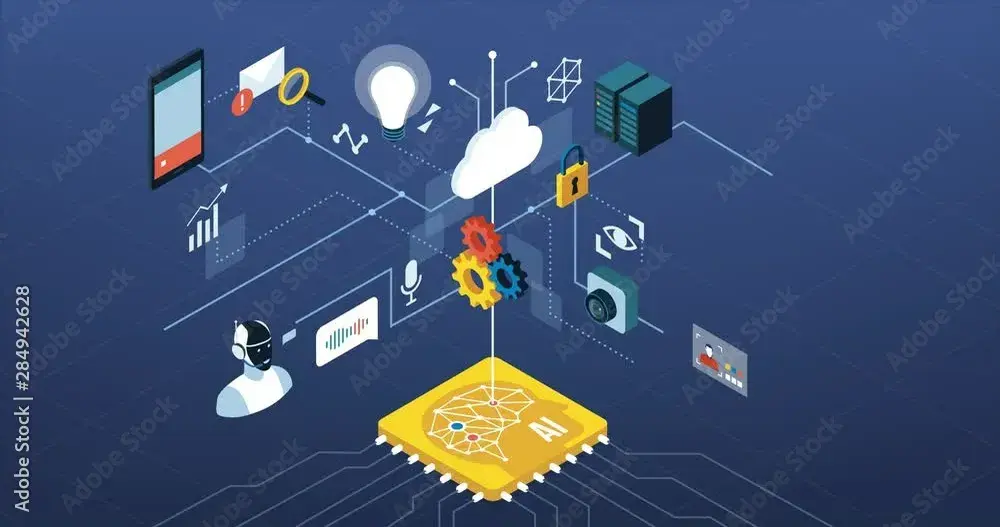
Add well-architected AI capabilities to your current application, including API integration, caching, fallback handling, and user-facing output design.
Custom Model Deployment
Custom Model Deployment
Host and serve models on your own cloud infrastructure with proper autoscaling, version management, health checks, and endpoint monitoring.
Feedback Loop Architecture
Feedback Loop Architecture
Build the feedback capture, labelling workflows, and retraining pipelines that allow your AI system to improve based on real-world usage data.
Production Monitoring
Production Monitoring
Instrument AI endpoints with latency tracking, output quality metrics, error rate alerts, and drift detection to maintain reliability in production.
How Businesses Use This
Real-world applications across industries — drag or click the cards to explore.


Adaptive Learning Platform
A learning application uses AI to assess a student's performance in real time and adjusts the difficulty and content of the next exercise to match their current level.
Business Outcomes You Can Expect
Full Data Ownership
Applications using self-hosted or custom-deployed models keep all user data and interaction logs within your own infrastructure.
Lower Long-Term Costs
Custom-deployed models have predictable infrastructure costs at scale compared to per-token API pricing that grows linearly with usage volume.
Production-Ready from Launch
Monitoring, fallbacks, and error handling are built in from the start, so the application is production-ready rather than requiring reactive fixes after go-live.
Improving Over Time
Feedback loops and retraining pipelines mean the AI component of your product improves with real-world usage rather than remaining static after launch.
Domain-Specific Performance
Fine-tuned models significantly outperform general-purpose models on domain-specific tasks, producing more accurate and relevant outputs for your users.
AI as a Core Function
When AI is designed into the application architecture from the start, it becomes reliable and central rather than fragile and peripheral.
Questions Before We Start
A Few Things Clients Usually Ask
Find answers to common questions about AI-Powered Apps solutions, setup procedures, scoping timelines, and deliverables.
Can AI capabilities be added to our existing application?
Yes. We assess your current application architecture and design an integration approach that adds AI capabilities cleanly without requiring a full rebuild. This typically involves adding an API layer, designing the inference call pattern, handling latency and error states in the UI, and implementing feedback collection.
Do you build custom models or use existing foundation models like GPT or Claude?
Both, depending on what the use case requires. Most business applications are best served by prompting or fine-tuning a foundation model rather than training from scratch, which would require far more data and compute. We use foundation models as the base and apply fine-tuning, RAG, or structured prompting depending on the accuracy and performance needs.
How do you handle AI errors or incorrect outputs in production?
We build explicit error handling into the application for AI outputs, including confidence thresholds, fallback responses when inference fails, and UI patterns that communicate uncertainty to users rather than presenting AI output as definitive. High-stakes outputs include a review step before they reach end users.
What does monitoring look like after the app is deployed?
We instrument AI endpoints with latency metrics, error rates, output quality samples, and usage volumes. Alerts fire when latency degrades or error rates rise above baseline. We also configure drift detection to flag when model outputs are deviating from expected patterns, which typically indicates the data the model was trained on no longer reflects real-world inputs.